
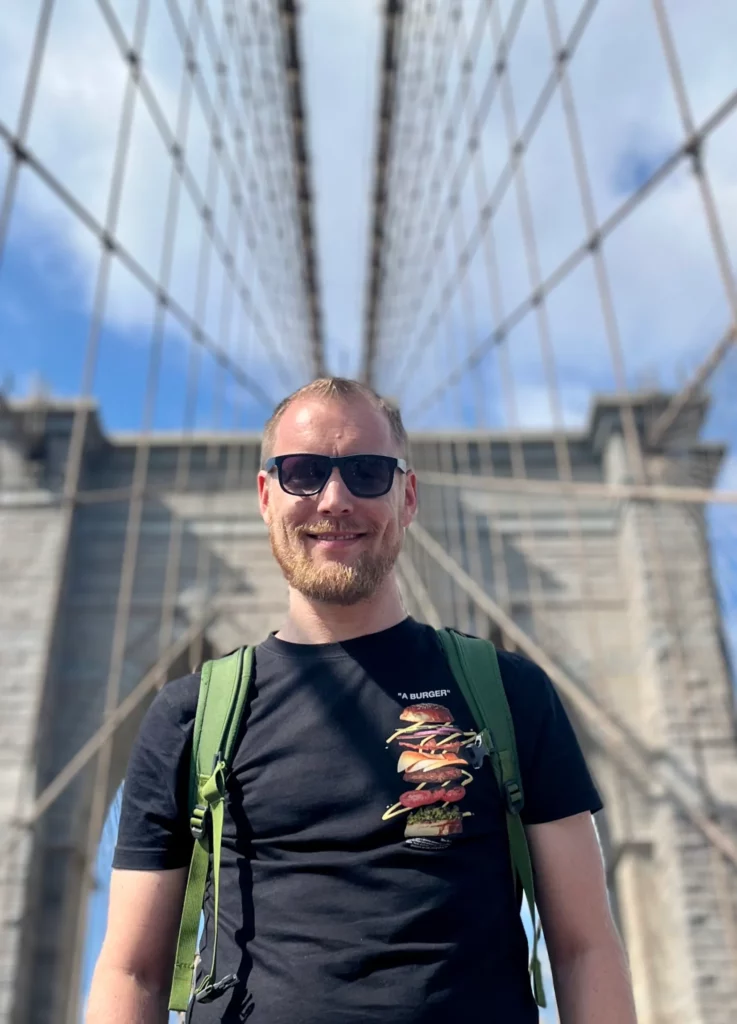
It’s now been 5 months since my surgery, 5 months with an engineered textile support around my aorta.
It’s been a year since the aneurysm in my ascending aorta was discovered by chance. I had a cough that had been bothering me for years investigated more thoroughly. A CT scan changed my life. An incidental finding, the pulmonologist said. It was clear that something wasn’t right, but the pulmonologist couldn’t give me much information. I got an appointment with the cardiologist two weeks later. These two weeks have been the strangest in a long time.
I came down with a bad case of the flu during those weeks. I coughed my lungs out, and with every cough, I was afraid something would happen to my aorta. Maddening, especially the first few days. During those two weeks, I felt like a ticking time bomb. It made me insecure: why do I have this? I’m healthy and young (36). How long have I been dealing with this? Am I dying?
During my visit to the cardiologist, the VSRR was discussed. It has a high success rate and is a proven method. The cardiologist said I was facing a difficult time, but that the ‘rest of my life’ would begin after the surgery. I immediately had confidence in this technique and felt much more reassured when I left the hospital. However, I was referred to Radboud University hospital, because the cardiologist considered me an academic case.
I first heard about the PEARS at the Radboud. The cardiologist mentioned this technique, which had been performed for the first time that month at this hospital. The cardiologist didn’t seem to consider surgery immediately; his advice was to first have a clinical genetics study done, and then use the results to further investigate. This study could easily take four months. Of course, I wanted to undergo this study, but I didn’t need it to know I wanted surgery. No, I knew very early on that I wanted surgery as soon as possible. I wanted to get rid of the problem, and the only way was to open up my chest. I was referred to the surgeon.
Until my consultation with the surgeon, I wasn’t sure which surgery I wanted: the VSRR or the PEARS. The VSRR had been well explained by the first cardiologist, and I therefore had a lot of confidence in that technique. The PEARS felt daunting, partly because I hadn’t fully researched it. Because I didn’t want to be driven crazy by Doctor Google, I had little information about the PEARS. However, the surgeon explained it clearly, and at that moment, I was immediately convinced. Of course, I wanted the PEARS; I only saw the advantages. I looked at my girlfriend and I saw the same in her eyes. The decision was made.
After this appointment, I was prepared for surgery, and the time had come at the end of August 2025. Because I had so much confidence in the technique and the surgeon, my tension in the final weeks before the surgery had disappeared. I was even looking forward to it. Finally, it was happening; finally, my problem was going to be solved.
The surgery went well. The days in the hospital afterward were much harder than I expected. I felt pain, felt sick, and was miserable. When I was allowed to go home after six days, I was doing well and quickly recovered at home. On day one, I started with two short walks a day and noticed that this quickly progressed to longer distances. I felt better and stronger every day.
Unfortunately, three weeks after discharge, I was readmitted with atrial fibrillation. The cause was fluid that had accumulated in my pericardium, which was putting pressure on my heart. After this fluid was removed (the most distressing moment of 2025, a drain inserted between my ribs and into my pericardium) and I had to take medication for a few weeks, the arrhythmia resolved on its own.
Now, five months later, I’m doing well, very well. Rehabilitation completed, no more medication. The rest of my life has begun.
It’s currently unclear what caused the aneurysm. My aortic valve is tricuspid and in perfect condition. The 54 genes currently known to cause this problem have been tested, but without results. So I don’t have Marfan syndrome or another connective tissue disease and, apart from asthma, I have no physical complaints. Will I ever find out where it comes from? I don’t think so. After a while now, I can live with that. I have complete confidence in my body again and that’s what all is about.
Thanks to Tal for the innovation, but also to the surgeons in the Netherlands who have stepped up as PEARS ambassadors. It’s thanks to you that the worst news of my life has been resolved in the best possible way.